
Performance testing in software testing is a technique for assessing a software application’s speed, reaction time, stability, dependability, scalability, and resource utilization under a specific load. Performance testing’s primary goal is to find and eliminate performance bottlenecks in software applications. It’s also known as “Perf Testing” and is a subset of performance engineering.
The aim of performance testing is to decide how well a software product performs.
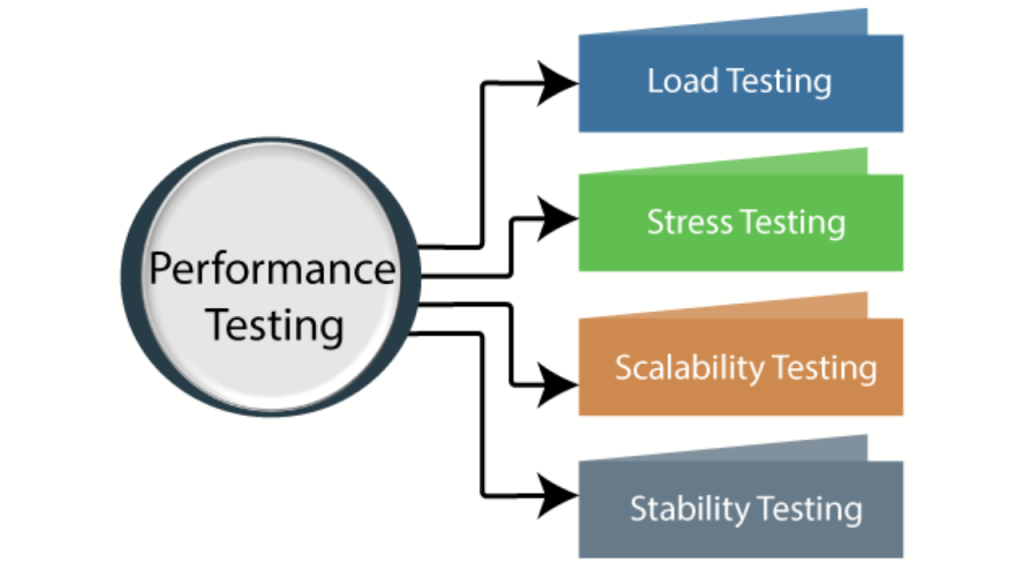
- Speed: The application’s speed determines how soon it reacts.
- Scalability: It refers to the software application’s ability to handle a certain amount of user traffic.
- Stability: Determines whether or not the appliance is steady once subjected to variable masses.
What is the purpose of Performance Testing in Software Testing?
Performance testing in software testing can be used as a diagnostic tool to find compute or communications bottlenecks. Bottlenecks are a single point or component inside the overall function of a system that slows down overall performance. Even the fastest computer, for example, will struggle to surf the web if the bandwidth is less than 1 megabit per second (Mbps). For online retailers, this type of testing can also be utilized to guarantee that an organization is prepared for a predictable significant event.
Types of Performance Testing in Software Testing

- Load testing: It evaluates an application’s ability to handle expected user loads. Before the software program goes online, the aim is to identify performance bottlenecks.
- Stress testing: It entails putting an application through its paces to assess. However, it reacts to excessive traffic or processing. The goal is to work out wherever an application’s edge is.
- Endurance testing: It ensures that the program can withstand the predicted load for an extended length of time.
- Spike testing: It examines the software’s response to huge spikes in user-generated load.
- Volume testing: It entails a large variety of tests. Data is entered into a piece of information, and the general behavior of the software system is monitored. The main aim is to test the performance of a software application with varied database volumes.
- Scalability testing: Measurability testing aims to check how well a software program “scales up” to sustain a rise in user load.
The Process of Performance Testing in Software Testing
Let us now attempt to list the many actions of Performance testing in order to gain a better grasp of the actual Performance testing procedure, which is given below:
Process of performance testing

- Examine the current situation
- Compile a list of the present system’s performance characteristics.
- Define the load distribution and usage model.
- Define the acceptable criteria for performance.
- Create the test assets, the test strategy, the test scripts, and the test scenarios.
- Set up the conditions for load generation.
- Carry out pre-planned testing
- Keep track of the performance counters on web servers, application servers, and database servers.
- Analyze and correlate the findings
- Produce reports
- Make suggestions for improving performance
- If necessary, repeat the test.
Some Advantages of Functional Testing.

- Examine the system’s ability to expand.
- Look for flaws in your design.
- Find bugs in software that were previously undetectable.
- The system should be fine-tuned.
- Examine the system’s ability to withstand failure.
 Quality professionals