
Mobile application testing assesses the functionality, usability, and consistency of mobile application software. Mobile applications can be downloaded or come pre-installed through mobile software distribution channels. In 2015, global mobile app revenues were 69.7 billion dollars, and in 2020, it was expected to be 188.9 billion dollars. According to Statista, by 2023, mobile users will have increased to 7.26 billion. The number of downloads of mobile apps is expected to reach 258 billion by 2022.
Major Challenges of Mobile App Testing Services
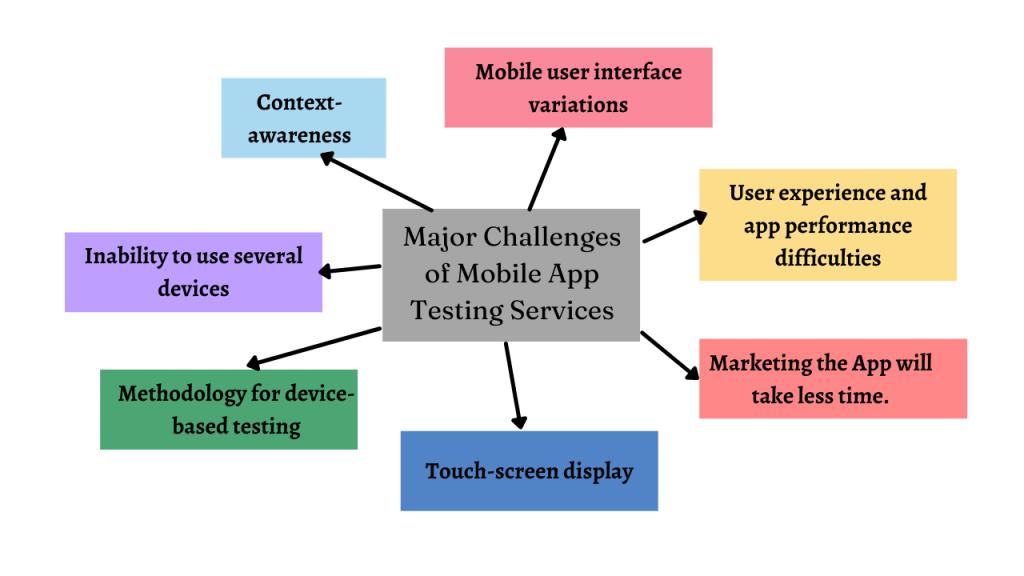
The following are some of the major problems faced by mobile app testing services:
User experience and app performance difficulties

A delay of more than two seconds might have a major impact on the user’s performance. The software should also have a new, well-designed, and pre-defined user interface. Mobile applications free of defects and flaws will provide a better user experience.
Touch-screen display

Data can be displayed and retrieved quickly and easily using a touch screen. It is now one of the most popular means of user interaction. Touch screen testing is more difficult and stable than other types of testing. Apart from that, signals or signs displaying data present a barrier in the testing process.
Context-awareness
Context-awareness is one of the most difficult aspects of mobile app testing, and it necessitates new and creative solutions. Mobile applications in various circumstances and with various data can often provide new challenges in the testing process. The surroundings and usage patterns of smartphones are always changing, which can impact context.
Marketing the App will take less time.

Impossible deadlines set by app developers may significantly impact mobile app testing. Different stages of mobile development are intertwined, and testing must be monitored. Users expect a mobile app to be delivered in as little as 20 days, which slows down the testing process. Great timelines must be set up for effective testing and the last deployment.
Mobile user interface variations

There are various user interfaces for operating systems, such as Windows, Android, and others. As part of the verification process, it is required to carry out a rigorous check on the layout of the elements. If apps do not follow the rules and regulations, the publishing process is delayed, which increases the cost of testing and development.
Inability to use several devices
Two testers may require identical gadgets simultaneously. It would be difficult for two testers to use the same gadgets. As a result, one tester will be left out until the other has finished. Multiple device procurement is time-consuming and costly. It’s also not a good idea to send testers across continents.
Methodology for device-based testing

This strategy necessitates the purchase of brand new mobile devices and the establishment of a testing facility. It is expensive, and this method must adapt to new mobile devices and platforms.
Mobile app testing services can be successful and worthwhile provided they follow a suitable, specialized, and systematic testing method. When testing mobile apps, it’s good to keep the above issues in mind.
 Quality professionals