
Non-functional testing focuses primarily on the software’s quality, particularly non-functional factors like response time, security, scalability, usability, and performance. Non-functional software testing ensures that a program meets the performance expectations that have been established and defined, and it includes all tests that are not covered by functional testing.
Objective

Any testing aims to identify existing issues in the program. Non-functional testing ensures the application’s durability and security, while functional testing ensures the seamless functioning of all essential functionalities. It becomes vital to design quality applications that can be developed utilizing web services testing at various stages of testing.
- Increase the application’s usability, efficiency, security, scalability, and adaptability.
- Ensure consumer happiness by ensuring that the application runs smoothly.
- The application’s installation, configuration, execution, management, and maintenance are practical and successful.
- Non-functional features have a significant reduction in risk and cost.
Listed below are the various types of non-functional testing.
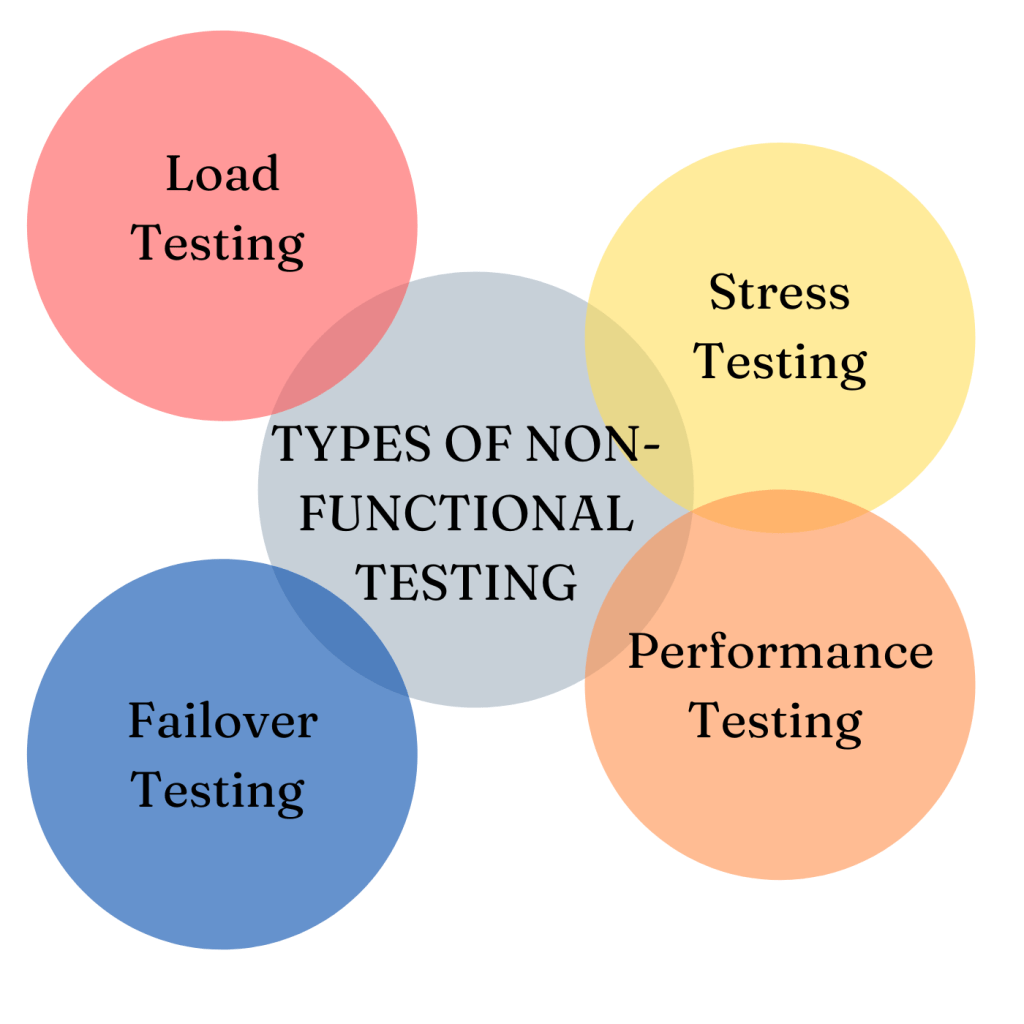
Performance Testing

Non-functional testing has the potential to be interchangeable with performance testing. It helps to evaluate the software’s performance and ensures that the reaction time matches the intended time. The application is considered for the response time of numerous business essential procedures by creating a large load and a production-sized database. Performance testing is also done as part of the integration process.
Load Testing
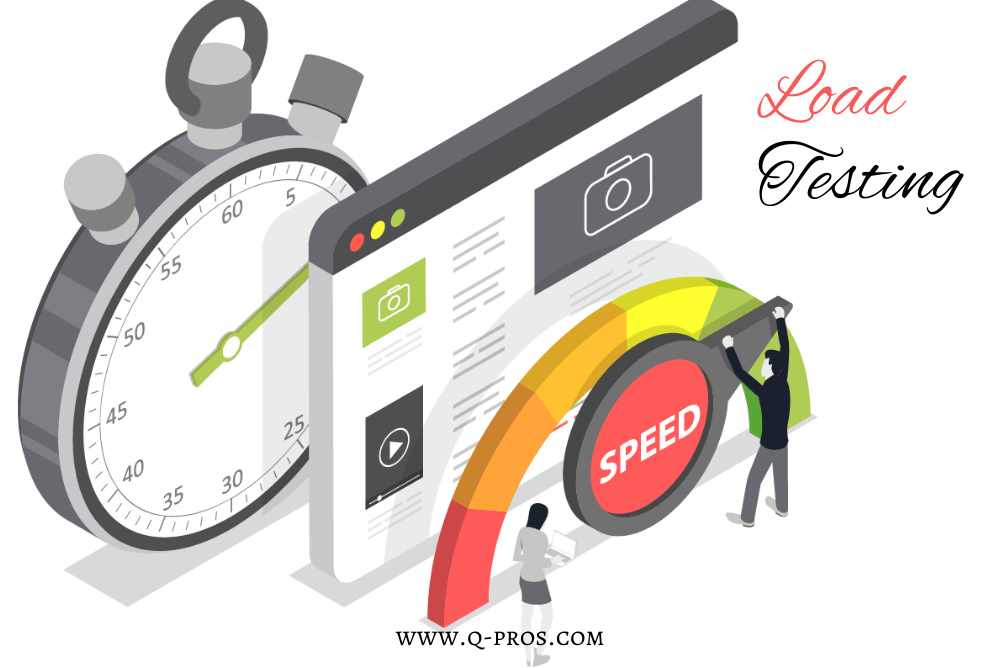
Load testing is done to see if the system can withstand the pressure or load of many users accessing the application at the same time. For obtaining accurate results from load testing, the production load is recreated in the test environment. The same test is run in real-time with different users to confirm the results. While maintaining a realistic database, the focus remains on achieving the target response time regardless of the number of users.
Stress Testing

Stress testing is done to see how the software reacts when pushed beyond its limitations. In contrast to load testing, when the maximum load capacity is produced, stress testing is performed when the load generated is greater than the application’s capability. As a result, it is regarded as a means of assessing application performance in critical scenarios.
Failover Testing
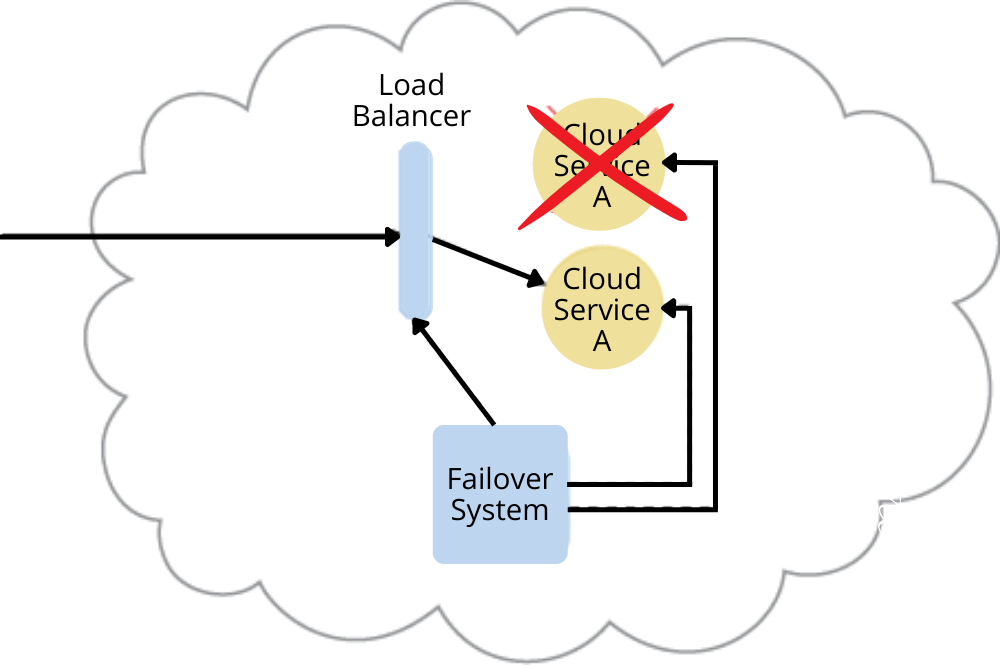
Failover non-functional testing assists in evaluating how the redundancy mechanism functions when the system is under excessive stress or has an unexpected breakdown. Furthermore, once the specific failed system has been restored, it must begin to work following the requirements; consequently, failover testing is not only essential but also critical in the application’s non-functional testing.
Don’t underestimate the worth that non-functional testing can bring to your application, as it can make or break your goals. All its associated objectives work to enhance the proficiency of your software. As a result, it helps the users to access the software without any difficulty. Choose your quality testing professionals wisely and let them determine which tests are necessary for your application and which tests will be automated to speed up the testing process.
 Quality professionals