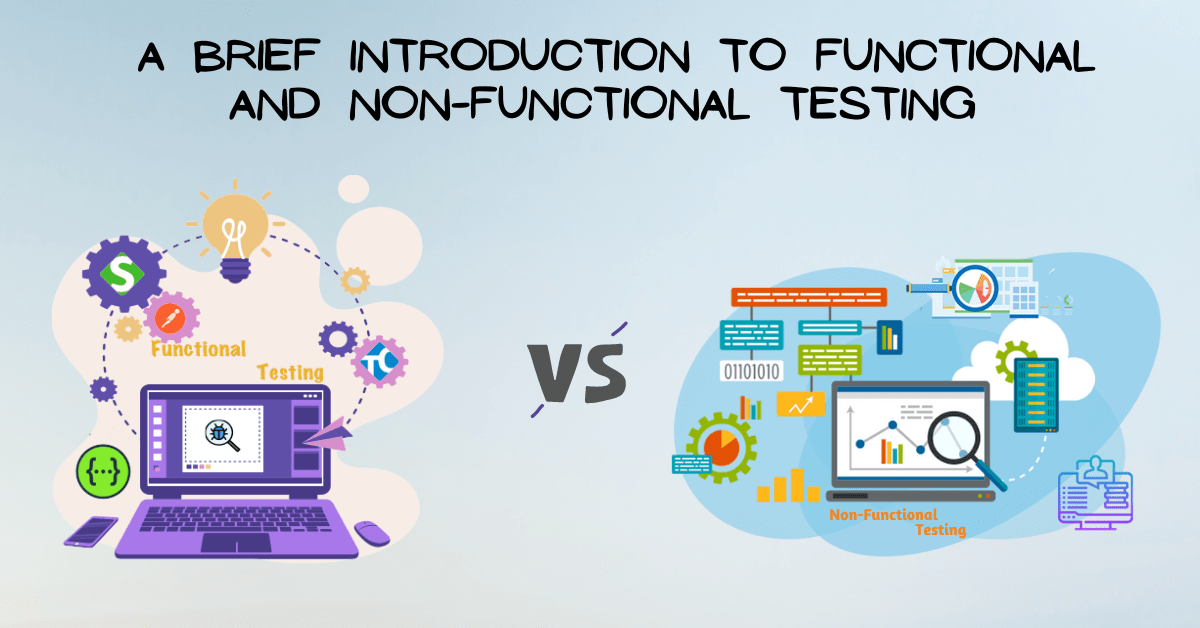
What comes to mind first when you think of software testing? Unit tests and integration tests are frequently on the minds of many engineers. A high-quality production codebase must be created and maintained using both software testing techniques. However, they don’t suffice on their own.
Your team’s testing procedure should evaluate the complete application, look broadly at how it functions when it is working correctly, and set sound alarms when deviations are discovered. A thorough software testing method must include both functional and non-functional testing to increase trust at each application tier.
Functional testing: What is it?
Functional testing is concerned with evaluating an application’s usability in light of a set of standards or requirements. A common practice in functional testing is to test specific sections of the underlying code.
Testing individual modules in isolation does not give a clearer picture than comparing actual outputs to intended behaviors. Errors typically occur when modules interact with one another.
Unit Testing
If a system is installed in a testing environment, unit tests for an API application could send requests and compare the results with the documentation. But there are only a few unit tests. Functional tests that cover the entire application frequently catch changes that unit tests miss when the application deviates or regresses in functionality.
Integration Testing
Software module integration testing verifies how they work together. The components rely on explicit contracts for how they interact when programmers create code as loosely connected modules, which is typically the best practice. Integration tests produce warnings when these interactions result in regressions and verify that each component of the product fulfills its contractual obligations.
User acceptance testing
The user acceptance phase of software testing aims to simulate real-world interactions and functionality by giving end users or their representatives’ access to some or all of the program. Due to its unreliability, expense, and time commitment, user acceptance testing is rarely significantly relied upon in healthy engineering cultures. Nevertheless, user acceptance testing is an essential step in the testing process for the majority of apps.
Closed-box testing
Closed-box testing of the entire application is another type of functional testing that is possible. Closed-box testing ignores the application’s internal workings in favor of only testing the application’s outputs. Many engineers tend to gravitate toward when writing functional tests to supplement their non-functional tests. Only the work is examined; the code that interacts with the outermost layers is automatically verified. For apps that only need API testing, this procedure is straightforward because the code only needs to make API calls and analyze the outcome.
Non-functional testing: what is it?
Non-functional testing evaluates aspects of a program that don’t directly affect its functionality but are nevertheless crucial for the user experience. Although they aren’t essential parts of a software system, performance and reliability under stress can make or break the user experience. Non-functional test failures don’t always result in a problem that users would experience, but they can point to a more significant systemic issue.
Performance Testing
Performance is the topic of one crucial non-functional testing procedure. A software system is tested for performance to make sure it responds to requests quickly. Poor latency ruins the user experience, and well-written performance tests frequently find issues before users notice them.
Load Testing
A comparable category of non-functional testing is load testing. Few systems can reply to a single request per second with the same speed as they can to 10,000 requests per second. A system’s ability to manage peak loads and fail gracefully when it lacks the capability to handle workload spikes is verified through load testing.
Usability Testing
Testing for usability evaluates how well a user interacts with a product. Usability testing is typically a manual technique that does not scale effectively. However, lack of usability testing, mainly when localizing software, sometimes results in messy and imprecise user interfaces. Incorporating this testing into your software development process is time well spent.
Security Testing
Another class of non-functional tests is security testing. To ensure that your team’s applications are safe and adequately handle data, you should test them frequently. Depending on how exposed an application is to potential attacks, security testing can range from routine penetration testing to automatic scanning. Many teams do not consider security testing a component of their testing arsenal. It makes sense to incorporate security testing and treat it like unit testing.
 Quality professionals